
Start with the job that is awkward in your home: finding a light from bed, reaching the bathroom, or keeping both hands free while helping someone. A flashlight, headlamp, lantern, and path light solve different problems. You may already have what you need; owning one of every category is not a readiness test.
This is a research-based comparison of categories with documented examples, not a hands-on review or product ranking. ReadyLience has not tested these products. The examples below illustrate a pocket flashlight, headlamp and alternative area-light power formats; manufacturer specifications are not measurements from household use.
The room-by-room emergency lighting plan owns placement, layers, battery standardization, and the test schedule. Read it first; this page only helps you choose what to put in that plan.
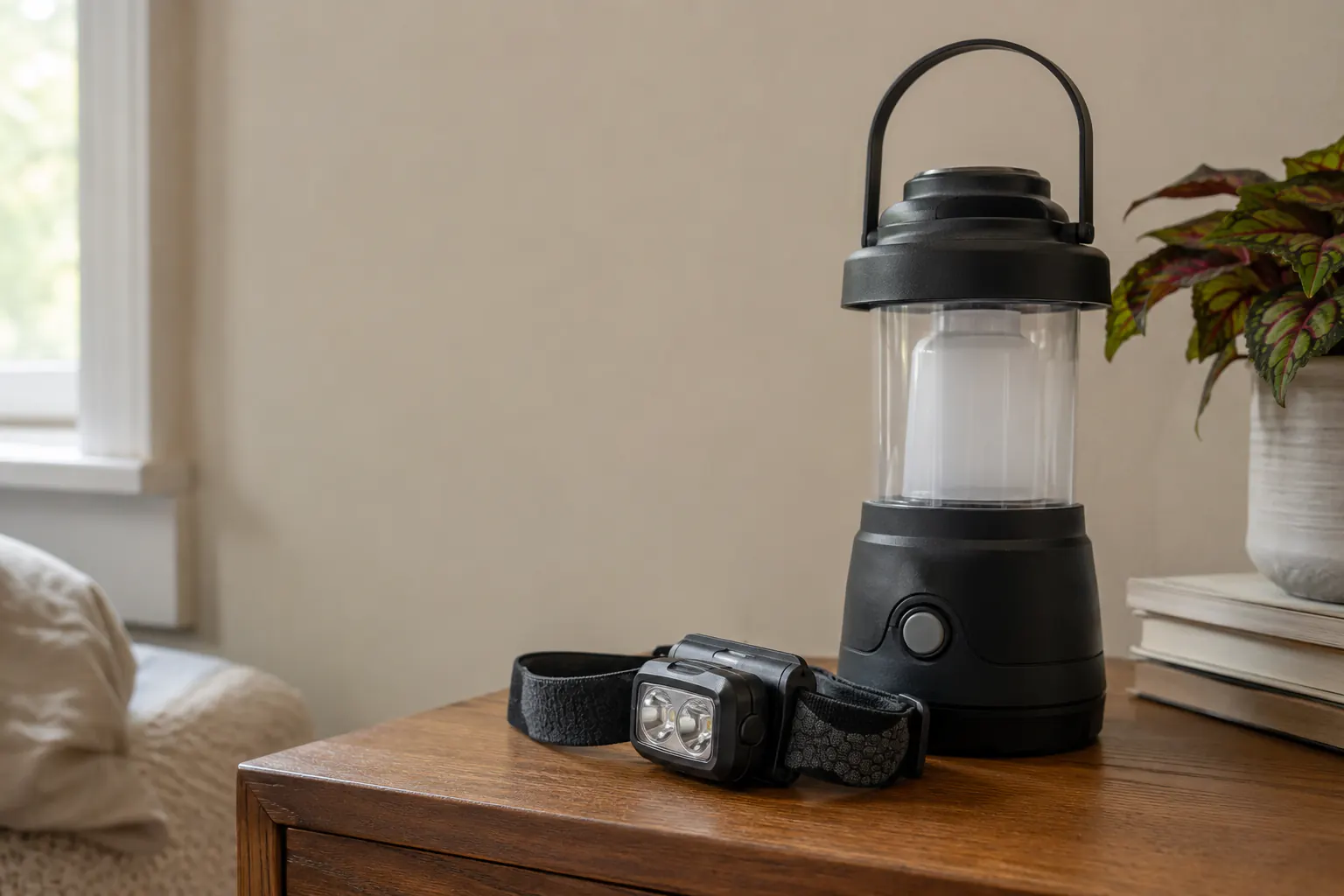
The rule that outranks every product choice
Use battery light, not flame. CPSC specifically recommends flashlights or battery-operated candles during outages, and warns never to leave a burning candle unattended. (Source: CPSC, 2026 winter storm and power outage safety warning.)
That is not a preference. Candles are a recurring cause of house fires during outages — exactly when the household is stressed, moving in the dark, and possibly asleep later. No lumen count, price, or aesthetic changes it. If you take one thing from this page, take that.
The four categories
| Category | The job it does | Main limit |
|---|---|---|
| Headlamp | Hands-free light for an ordinary task | Can create glare when aimed at faces; fit and controls matter |
| Lantern | Area light for an occupied room; people can see each other | Poor for tasks needing directed light; glare if placed at eye level |
| Flashlight | Directed light for a hallway or ordinary reading | One hand occupied; narrow beam is bad for area lighting |
| Path / motion light | Passive marking of stairs, halls, and exits so nobody carries anything | Low output; not a work light |
The pattern is hands-free, area, directed, passive. Use the room plan to identify the missing job before adding another light.
Headlamps: the most underrated category
A headlamp directs light where you look while leaving both hands free. That can help when carrying supplies, reading a label, or helping another person without asking someone else to hold a flashlight.
Strengths: hands-free light that follows where you look. Check the particular lamp’s weight, controls and useful brightness rather than assuming that every headlamp is inexpensive or lasts a long time.
Limits and honest cautions:
- A beam aimed at another person’s face can create uncomfortable glare. That matters when helping someone or talking to a neighbor. Check the beam position and a suitable low setting; a red mode is not a reason to ignore the eye-exposure warning.
- It is easy to store somewhere sensible and forget. Placement is the plan’s job.
- Elastic and battery contacts age in storage.
What to look for in research: low and red modes rather than headline lumens, measured runtime on the setting you would actually use, battery format matching the rest of the kit, and simple controls usable in the dark by someone who is stressed.
Lanterns: for the room people are in
A lantern is the category that makes a room livable rather than navigable. It is what turns “we have light” into “we can sit together.”
Strengths: area light that does not need to be held when the particular model has a suitable stable placement. Runtime, controls and age-appropriate use differ by model; no lantern is automatically suitable for a child or an older adult.
Limits: poor for tasks that need directed light; a bright lantern at eye level can produce uncomfortable glare. Use a stable location clear of walking routes, with the beam away from faces, and follow the light’s mounting instructions.
What to look for: stability on a table, a genuinely usable low mode, diffusion rather than raw brightness, and whether it can be hung.
Flashlights: directed and familiar
The default household purchase, and the one people over-buy. A flashlight is right when you need light there rather than here.
Strengths: a directed beam and a format many households already know. Check the actual user’s controls and the manufacturer’s permitted conditions; a familiar shape does not establish weather resistance or durability.
Limits: occupies a hand, poor as area light, and tempting to use as a headlamp substitute for work it is bad at.
What to look for: a beam suited to household distances rather than tactical throw, and a battery format that matches the rest of your kit.
A light kept on keys or a zipper may be convenient for briefly reading a card, but that does not make it a night-long reserve. Compare an attached format only when the location of your existing light is the actual problem. The Pocket Mate uses a sealed rechargeable battery; the Nano Light II uses one AAAA alkaline cell, not AAA. Those are alternative power and control choices, not two extra lights everyone needs.
Path and motion lights: marking a route
Small plug-in or battery lights on stairs, hallways, and exits work when nobody is holding anything. Their job is to make steps and obstacles visible without requiring someone to fetch a handheld light first.
Strengths: a suitable automatic light can make a familiar route easier to see without occupying a hand. Check its placement, activation and outage behavior with the actual user; lighting does not remove trip hazards or guarantee against falls.
Limits: low output, not a work light, and plug-in units without battery backup are useless in the outage they were bought for. Check that specifically.
Batteries decide more than brightness
The category comparison matters less than whether the light works in month eight of storage.
The lighting plan covers standardization in detail, and it is the higher-value read. The short version: choose a small number of battery formats so spares move between devices, do not mix old and new cells or chemistries, store loose batteries so terminals cannot contact metal, and test runtime on low and medium rather than trusting an optimistic maximum.
A rechargeable light adds a dependency: it needs a charging source during an outage. A power bank with a built-in light is primarily a phone reserve — do not drain communication power for area lighting. The backup power hub covers the budget that lighting draws from, and it is a small draw compared with almost anything else, which is exactly why lighting is the load worth protecting.
DOE’s guidance to measure actual use rather than trust nameplate figures applies here too. (Source: U.S. Department of Energy, Estimating Appliance and Home Electronic Energy Use.) If you want a real number, a plug-in watt meter will tell you what a charger actually pulls.
What the marketing numbers do not tell you
- Match output to runtime. Check which brightness setting a runtime figure describes. A maximum-output claim and a longest-runtime claim may refer to different modes.
- Read the test conditions. Check the stated setting, temperature, cells, and useful-output endpoint. Do not assume those conditions match your household use.
- “Emergency” on the box means nothing. It is a marketing word, not a standard.
- Waterproof ratings are specific. They describe a defined test, not a promise about your storm.
- Solar and crank lights are supplements. Crank output is genuinely small per minute of effort; solar depends on placing the light where the sun is, which is rarely where you need it.
A decision path
- Rule out flame. Battery light only. CPSC guidance, not preference.
- Identify who needs hands-free task light. Check whether an existing headlamp fits that person’s controls, task, and age-appropriate use before buying another.
- Check the shared room’s area light. An existing lantern may cover the job; compare another only if there is a real gap.
- Keep one or two flashlights for directed and outdoor use — you probably already have them.
- Add path lights on stairs and hallways, with battery backup verified.
- Standardize the battery format across all of it, then test on low and medium.
- Place them per the room plan, because a light in a drawer you cannot find in the dark is not a light.
What a credible review would record
Before presenting a lighting product as personally tested or a measured winner, an honest test would document:
- measured runtime at a stated setting and temperature, not the box figure;
- output stability over the run rather than at switch-on;
- performance in cold, which is when outages happen;
- usability in the dark by someone who has not read the manual;
- battery format, self-discharge over a real storage interval, and behavior at low battery;
- durability after a drop, and water exposure against a stated rating;
- exact test conditions, instruments, and sample count.
The linked examples are research-based options with nearby affiliate disclosures. They do not satisfy that testing protocol, prove that a light fits a particular person, or establish household runtime. Buying one does not replace checking the lights and battery reserve you already have.
Sources reviewed
The existing framework uses CPSC winter-storm and power-outage guidance, Ready.gov blackout guidance, U.S. Fire Administration candle guidance, CDC emergency power-source guidance, and DOE energy-use guidance. Those organizations do not endorse the linked products.
Coleman’s BatteryGuard 1000 documentation, Black Diamond’s Spot 400 documentation, Streamlight’s MicroStream 66318 documentation and the three exact Amazon listings were checked October 11, 2026 for model identity, power format, controls and lighting role. This does not renew every historical safety-source review or certify recall status. No lighting product has been tested by ReadyLience. No light makes an unsafe building safe to occupy; emergency services, utilities and building authorities control evacuation and re-entry.
Goal Zero’s Lighthouse Mini Core documentation and the exact single-lantern 32011 listing were checked October 12, 2026 for model identity, USB charging, fold-down legs and battery-sharing limits. No charging time, runtime, mounting or stability result was measured. Follow the current product instructions and warnings.
Streamlight’s Siege AA documentation, operating instructions and exact single-item 44941 Coyote listing were checked October 12, 2026. Three AA alkaline cells, the removable cover and the battery indicator are documented features, not measured household performance. Follow the LED-eye-exposure warning; no light makes an unsafe place safe.
The additional Streamlight 44931, 66118, 61125 and 61702 instructions, Goal Zero 32005 guide, Black Diamond Moji instructions and Petzl TIKKINA notice were reviewed October 12, 2026 against their exact selected listings. Manufacturer warnings and mode-specific limits control the comparison. Contradictory drop, warranty, chemistry, dimensions or generic retailer fields were not converted into product claims. No price, measured performance, medical use, road certification or rescue outcome is promised.
Streamlight’s current linked English instructions and part sheets for 73300, 73020 and 61421, and their exact single-item US listings, were reviewed October 13, 2026. The attached sealed-battery light, rotary AAAA light and spot/flood AAA headlamp are documented format and control alternatives, not tested improvements. Manufacturer runtime figures do not establish household runtime; older warranty language, generic multi-mode fields and unsupported charging or battery chemistry were not adopted. No product or supplied package was physically inspected.